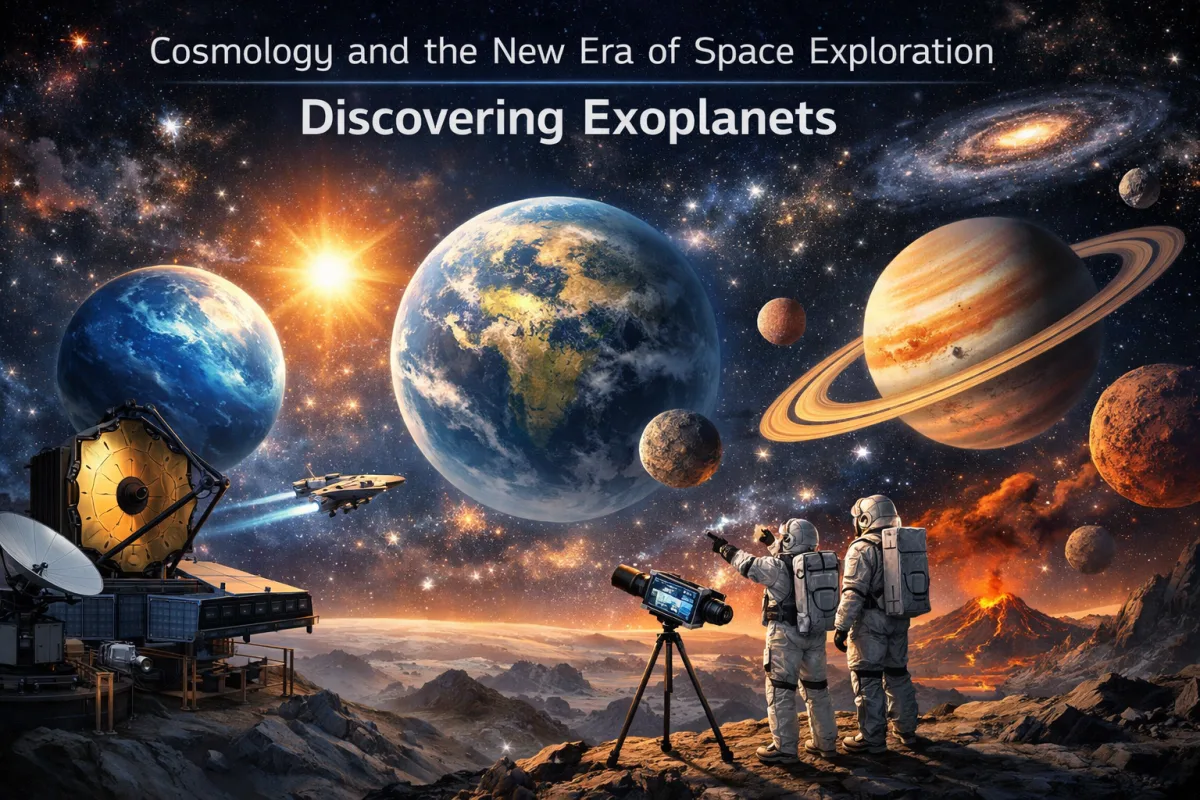
For millennia, we've gazed at the stars, wondering if we're alone. That's a question rooted deeply in cosmology, the study of the universe's origin, evolution, and fate. Now, we're not just wondering; we're actively searching and finding. We've entered a truly breathtaking new era of space exploration, one profoundly defined by the systematic, relentless, and increasingly successful mission of discovering exoplanets – worlds orbiting stars beyond our Sun. This isn't just about finding distant points of light; it's about fundamentally altering our cosmic perspective.
The Cosmic Tapestry: Why Exoplanets Matter to Cosmology
Cosmology paints the grand picture of the universe, from the Big Bang to the formation of galaxies and stars. Exoplanets, these alien worlds, are tiny threads within that vast tapestry, yet their discovery offers crucial insights into the processes that shape planetary systems. They tell us how common planets are, how they form, and what conditions prevail across the cosmos.
Our understanding of planetary formation was once limited to our own solar system. We assumed our arrangement of small, rocky inner planets and gas giants further out was the norm. The discovery of thousands of exoplanets has shattered that narrow view, revealing a stunning diversity that forces cosmologists to refine their models of star and planet formation.
It's a feedback loop: cosmological models predict the environments where planets might arise, and exoplanet discoveries then validate or challenge those predictions. This dynamic interplay pushes the boundaries of our knowledge, helping us piece together the complete story of cosmic evolution.
The Kepler Revolution and Beyond: Pioneering Exoplanet Discovery
The hunt for exoplanets wasn't always so fruitful. For centuries, they remained theoretical. The first confirmed exoplanet around a Sun-like star, 51 Pegasi b, wasn't found until 1995. That discovery opened the floodgates, but it was NASA's Kepler Space Telescope that truly revolutionized the field.
Launched in 2009, Kepler stared intently at a single patch of sky in the Cygnus-Lyra region, monitoring the brightness of over 150,000 stars. It used the "transit method," looking for tiny, periodic dips in a star's light, which indicate a planet passing in front of it. This mission proved that planets are not rare; they're incredibly common.
By the end of its operational life, Kepler had confirmed over 2,600 exoplanets, with thousands more candidates. Its successor, the Transiting Exoplanet Survey Satellite (TESS), launched in 2018, takes a wider approach, surveying nearly the entire sky to find transiting planets orbiting bright, nearby stars. TESS has already discovered hundreds of new worlds, making them easier to follow up with ground-based telescopes and the James Webb Space Telescope (JWST).
- Transit Method: Detects slight dimming of a star's light as a planet passes between it and us.
- Radial Velocity Method (Doppler Spectroscopy): Measures tiny wobbles in a star caused by the gravitational tug of an orbiting planet.
- Direct Imaging: Blocking out a star's light to directly photograph an exoplanet, typically large, distant ones.
- Microlensing: Uses the gravitational distortion of spacetime by a foreground star to detect background planets.
Worlds Stranger Than Fiction: The Diversity of Exoplanets
What have we found? A dizzying array of planetary types that challenge our solar system-centric view. We've discovered "Hot Jupiters," gas giants orbiting incredibly close to their stars, with years lasting mere days. There are "Super-Earths," rocky planets larger than Earth but smaller than Neptune, a class of planet not found in our own system.
We've also found "mini-Neptunes," "ocean worlds," and even "lava worlds" like CoRoT-7b, where temperatures are so extreme that rock vaporizes. The TRAPPIST-1 system, famously, hosts seven Earth-sized planets, three of which reside within the star's habitable zone, where liquid water could potentially exist on their surfaces. This discovery alone dramatically increased our optimism about finding life.
Rogue Planets: Wanderers of the Void
Perhaps one of the most enigmatic discoveries is that of "rogue planets" or "free-floating planets." These are worlds that have been ejected from their parent star systems and wander through interstellar space, unattached to any star. While difficult to detect, astronomers estimate there could be billions of them in our galaxy alone, far outnumbering stars. They're cold, dark, and utterly isolated, offering another fascinating extreme in the exoplanet landscape.
The Search for Life: Biosignatures and Habitability
The ultimate goal for many in the new era of space exploration isn't just to find exoplanets, but to find habitable ones, and perhaps, signs of life. The concept of a "habitable zone" – the region around a star where temperatures allow liquid water to exist on a planet's surface – guides much of this search. But habitability is complex; it also depends on atmospheric composition, geological activity, and the presence of a protective magnetic field.
How do we look for life? By searching for "biosignatures" – chemical compounds or combinations of compounds in a planet's atmosphere that are strongly indicative of biological processes. Oxygen, methane, and water vapor in specific ratios could be potential signs. The JWST, with its unparalleled infrared capabilities, is already beginning to analyze the atmospheres of distant exoplanets, providing unprecedented data.
Are we looking for Earth 2.0, or are we open to life in forms we can't yet imagine? That's a profound question driving current astrobiological research. The possibilities are truly mind-boggling.
Next-Generation Telescopes: Powering Exoplanet Discoveries
The future of discovering exoplanets is brighter than ever, thanks to a new generation of incredibly powerful telescopes. The James Webb Space Telescope (JWST) is already delivering spectacular results, providing detailed atmospheric compositions of exoplanets, including the first clear detection of carbon dioxide in an exoplanet's atmosphere.
Looking ahead, missions like NASA's Nancy Grace Roman Space Telescope, set to launch later this decade, will utilize microlensing to detect thousands more exoplanets, particularly those further from their stars. On the ground, projects like the European Extremely Large Telescope (ELT) in Chile, with its 39-meter primary mirror, will be able to directly image smaller exoplanets and analyze their atmospheres with incredible precision.
The European Space Agency's ARIEL (Atmospheric Remote-sensing Infrared Exoplanet Large-survey) mission, scheduled for launch in the 2030s, will focus specifically on studying the atmospheres of a large, diverse sample of exoplanets. These instruments will provide the data we need to move beyond simple detection to detailed characterization, helping us understand true habitability.
What This Means for Us: A Cosmic Perspective Shift
The relentless pace of exoplanet discoveries isn't just for scientists; it has profound implications for every one of us. It's a constant, powerful reminder of our place in the cosmos. We're not at the center, nor are we necessarily unique. This realization can be humbling, yet also incredibly inspiring.
It fuels our sense of wonder and encourages critical thinking about life, its origins, and its potential forms. Learning about these diverse worlds pushes humanity to innovate, developing new technologies and scientific methods that have ripple effects across countless industries. Perhaps most importantly, it offers a broader perspective on the challenges we face on our own planet. If there are countless other worlds, how precious is this one?
This new era of space exploration, driven by the search for exoplanets, reshapes our understanding of cosmology and our very existence. It shows us that the universe is far richer and more varied than we ever dared to imagine. Every new world discovered is a testament to human ingenuity and our unyielding curiosity.
We're living through a golden age of discovery, where the boundaries of our universe are expanding with every new exoplanet identified. The question of "Are we alone?" is slowly transitioning from philosophy to empirical science, and the answers we're beginning to uncover are more astonishing than any fiction. Keep looking up; the universe is full of surprises.