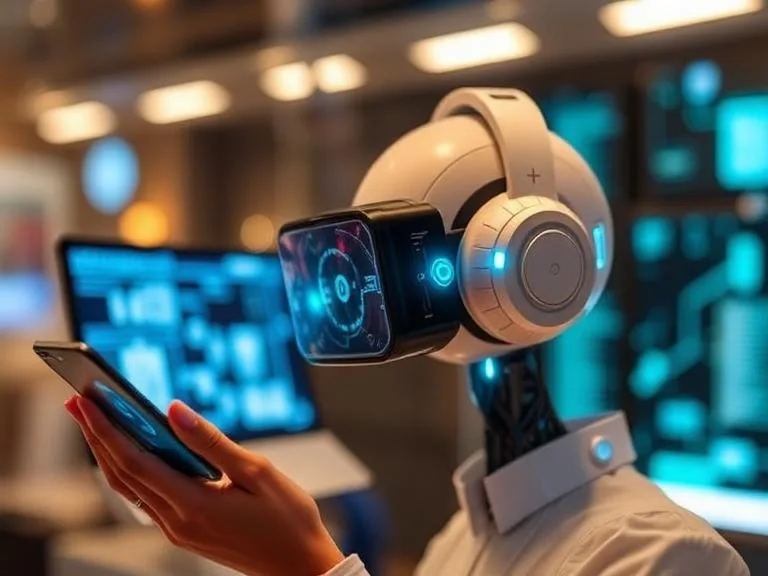
The future isn't a distant horizon anymore; it's a rapidly accelerating present, brimming with innovations poised to fundamentally alter how we live, work, and interact. We're on the cusp of a technological revolution that will redefine everyday life in ways we’re only just beginning to grasp. Forget incremental updates; we're talking about paradigm shifts that will touch every facet of our existence.
From the microscopic realm of our DNA to the expansive canvas of digital realities, groundbreaking advancements are emerging. These aren't just gadgets or fleeting trends; they represent the foundational pillars of our next societal evolution. Let's explore the key emerging technologies that are set to reshape our world.
Hyper-Personalized Health and Longevity: A New Era of Wellness
Imagine healthcare that's not just reactive but predictive, tailored precisely to your unique biology. That's the promise of hyper-personalized health, driven by genomics, advanced diagnostics, and AI. Doctors will soon use your genetic blueprint, lifestyle data, and real-time physiological monitoring to craft prevention and treatment plans before symptoms even appear.
CRISPR gene-editing technology, for instance, isn't merely a research tool; it's already showing remarkable potential in clinical trials. Vertex Pharmaceuticals and CRISPR Therapeutics, for example, have developed a CRISPR-based therapy that effectively treats sickle cell disease and beta thalassemia, offering a functional cure for previously debilitating genetic conditions. This isn't just about treating illness; it's about correcting fundamental flaws at the source.
- Genomic Sequencing: Affordable and accessible whole-genome sequencing will become routine, unlocking personalized risk assessments for diseases like cancer and Alzheimer's.
- AI-Powered Diagnostics: Artificial intelligence will analyze medical images, pathology slides, and patient data with unparalleled accuracy, identifying diseases earlier than any human eye.
- Bio-Wearables and Implants: Discreet sensors will continuously monitor vital signs, glucose levels, and even stress hormones, providing a constant stream of actionable health data directly to you and your care team.
- Personalized Therapeutics: From custom-designed drugs to mRNA vaccines tailored for individual cancer types, treatments will be far more effective with fewer side effects.
This shift means you'll hold more power over your health than ever before. You'll move from being a patient to an active participant, leveraging data and cutting-edge science to extend your healthspan, not just your lifespan.
Immersive Digital Realities: Blurring the Lines of Experience
The internet fundamentally changed how we connect; now, immersive digital realities are poised to transform how we experience the world. Extended Reality (XR) — an umbrella term encompassing Virtual Reality (VR), Augmented Reality (AR), and Mixed Reality (MR) — will move beyond gaming and entertainment to integrate seamlessly into our professional and personal lives.
Think about remote work reimagined. Instead of flat video calls, you'll collaborate with colleagues in a shared virtual workspace, manipulating 3D models and brainstorming on infinite whiteboards as if you're in the same room. Companies like Meta and Apple are investing billions, with devices like the Apple Vision Pro demonstrating the initial consumer push towards spatial computing. The global AR/VR market size reached an estimated $49 billion in 2023, and analysts predict it will surge to over $250 billion by 2030, indicating rapid adoption and integration.
The Metaverse: A Persistent Digital Frontier
The concept of the metaverse isn't just a buzzword; it's the vision of persistent, interconnected virtual worlds where you can socialize, work, shop, and create. It's an evolution of the internet into a 3D, embodied experience. You'll attend concerts as an avatar, try on clothes virtually before buying them in the real world, or even learn complex skills through hyper-realistic simulations.
This isn't just about escapism; it's about expanding human potential. Surgeons can practice intricate procedures, architects can walk clients through unbuilt structures, and students can explore ancient civilizations firsthand. These technologies will redefine everyday life by offering new dimensions for creativity, connection, and commerce.
Sustainable Living Through Advanced Materials and Energy
As the urgency of climate change grows, so does the innovation in sustainable technologies. We're seeing breakthroughs in materials science and energy production that promise a greener, more efficient future. These innovations aren't just about reducing harm; they're about creating entirely new systems for living.
Consider the revolution in battery technology. Beyond lithium-ion, solid-state batteries offer higher energy density, faster charging, and greater safety, potentially quadrupling the range of electric vehicles and making grid-scale energy storage more viable. Companies like QuantumScape are making significant strides, pushing these next-generation power sources closer to commercial reality.
New "smart" materials are also emerging, capable of self-healing, self-cleaning, or even generating energy from ambient light or movement. Imagine infrastructure that repairs itself, clothing that purifies air, or buildings that act as giant energy collectors. These advancements will embed sustainability directly into the fabric of our built environment.
The Rise of Autonomous Systems and Robotics
Robots and autonomous systems are no longer confined to factory floors. They're moving into our homes, our streets, and even our skies, promising to automate mundane tasks, enhance safety, and create unprecedented efficiencies. This is one of the most visible emerging technologies that will redefine everyday life.
Self-driving cars are perhaps the most talked-about example. Companies like Waymo and Cruise are already operating fully autonomous taxi services in select cities, demonstrating levels of safety that often surpass human drivers. The National Highway Traffic Safety Administration (NHTSA) data consistently shows autonomous vehicles involved in significantly fewer accidents per mile than human-driven ones, especially concerning critical incidents.
Beyond transportation, domestic robots are becoming more sophisticated, capable of not just cleaning but also providing companionship, security, and assistance for the elderly or those with disabilities. Delivery drones and automated logistics networks will streamline supply chains, making goods cheaper and more accessible. What will you do with the extra time these robots free up?
Brain-Computer Interfaces (BCIs): Connecting Minds to Machines
Perhaps the most profound and ethically complex of the emerging technologies, Brain-Computer Interfaces (BCIs) aim to create a direct communication pathway between the human brain and external devices. While still in early stages, the implications are staggering.
Currently, BCIs are transforming lives for individuals with severe paralysis, allowing them to control prosthetic limbs or communicate through thought alone. Companies like Synchron have developed implantable BCIs that let patients tweet or email just by thinking, bypassing traditional input methods entirely. Neuralink is also making headlines with its ambitious goals for high-bandwidth brain interfaces.
In the future, BCIs could move beyond medical applications. Imagine interacting with your computer or smart home simply by intending an action, or even experiencing sensory input directly into your brain. This technology holds the potential to augment human capabilities, enhance learning, and even change how we perceive consciousness itself. The ethical debates around privacy, autonomy, and identity will be as crucial as the technological advancements.
What This Means For You: Navigating the New Normal
These transformative technologies aren't just for scientists or early adopters. They will touch everyone. Understanding their potential impact is the first step in preparing for a future that will look vastly different from today.
Here's what you can do:
- Embrace Lifelong Learning: The skills valued today might be obsolete tomorrow. Cultivate adaptability, critical thinking, and a willingness to learn new tools and concepts.
- Engage Ethically: As these technologies develop, participate in conversations about their ethical implications. Your voice matters in shaping how they're used.
- Prioritize Digital Literacy: Understand how data is collected, used, and protected. This will be crucial for navigating personalized services and immersive environments.
- Focus on Human Skills: Creativity, emotional intelligence, complex problem-solving, and collaboration will become even more valuable as routine tasks are automated.
The future isn't something that happens to us; it's something we build. Your active engagement and informed perspective will be vital in ensuring these emerging technologies serve humanity's best interests.
A Future Redefined, Not Just Enhanced
We stand at a pivotal juncture, where the lines between science fiction and reality blur with astonishing speed. The emerging technologies discussed here – from personalized health and immersive realities to sustainable energy and brain-computer interfaces – aren't just improvements on existing systems; they represent fundamental shifts in how we understand and experience life. They'll reshape our homes, our workplaces, our bodies, and even our minds. This isn't just about convenience; it’s about a profound redefinition of human potential and societal structure. Get ready for a world that's more connected, more intelligent, and more capable than anything we've known before.