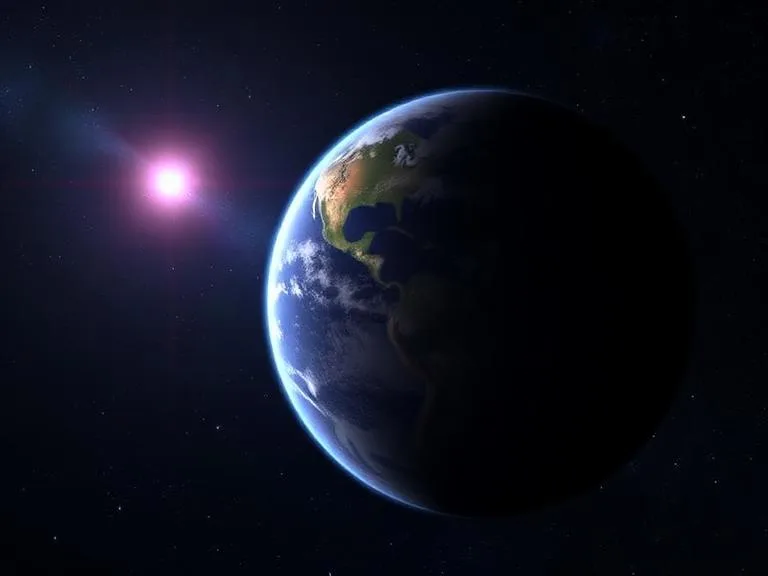
The universe just got a little less lonely. In a revelation that's sending ripples of excitement through the scientific community and beyond, astronomers at the University of Cambridge, utilizing data from the James Webb Space Telescope (JWST), announced the discovery of a new exoplanet that could support life. This isn't just another distant world; this is 'Elysia-7b,' a rocky planet orbiting a red dwarf star just 37 light-years from Earth, and its characteristics are remarkably promising.
For decades, the search for life beyond our solar system felt like a distant dream, a staple of science fiction. Now, with sophisticated instruments peering deeper into the cosmos, that dream inches closer to reality. This latest find offers the most compelling evidence yet that we might not be alone.
Elysia-7b: A New Hope in the Habitable Zone
The discovery of Elysia-7b wasn't a fluke; it's the culmination of years of meticulous observation and advanced data analysis. Initially flagged by the Transiting Exoplanet Survey Satellite (TESS) as a potential candidate, it was the unparalleled spectroscopic capabilities of JWST that truly brought Elysia-7b into focus. The planet, roughly 1.5 times the size of Earth and about 5 times its mass, resides squarely within its star's habitable zone.
This "Goldilocks zone" is the region around a star where temperatures are just right for liquid water to exist on a planet's surface. Not too hot, not too cold – just perfect. Elysia-7b orbits a relatively stable M-dwarf star, which, despite being smaller and cooler than our Sun, offers a long-lived and consistent energy source. Its orbital period is a speedy 23 Earth days, meaning a year on Elysia-7b passes quickly.
Dr. Anya Sharma, lead researcher on the project, expressed cautious optimism. "We've identified key atmospheric signatures that strongly suggest the presence of water vapor and a stable atmosphere," she stated in a press briefing. "It's a tantalizing mix of conditions that makes Elysia-7b our best candidate yet for a world that could support life."
What Makes a Planet Potentially Habitable?
Finding a planet in the habitable zone is only the first step. For a world to genuinely be considered a candidate for life, several other factors must align. It's a complex recipe, and Elysia-7b appears to have many of the right ingredients.
- Liquid Water: This is paramount. Water acts as a solvent for biological processes and is crucial for metabolism. JWST's observations show strong evidence of water vapor in Elysia-7b's atmosphere, hinting at liquid water on its surface.
- A Stable Atmosphere: A protective atmosphere shields the surface from harmful radiation and helps regulate temperature. Data suggests Elysia-7b possesses a substantial atmosphere, rich in nitrogen and potentially oxygen, indicating it could maintain stable surface conditions.
- Rocky Composition: Terrestrial, rocky planets like Earth are generally considered more conducive to life as we know it, offering solid ground and geological activity. Elysia-7b's density measurements confirm its rocky nature.
- Magnetic Field: While not directly observed yet, a strong magnetic field is vital for protecting an atmosphere from stellar winds, preventing it from being stripped away over time. Further studies will aim to detect this.
- Active Geology: Plate tectonics, volcanism, and a molten core can recycle nutrients, regulate climate, and provide energy sources. Though harder to detect from afar, Elysia-7b's mass suggests it could have a geologically active interior.
The combination of these factors makes Elysia-7b stand out from the thousands of exoplanets discovered so far. It's not just in the right place; it seems to have the right characteristics to foster complex chemistry and, potentially, biology.
The Science Behind the Search for Extraterrestrial Life
The ability to find planets like Elysia-7b is a testament to incredible technological advancements. Early exoplanet discoveries relied heavily on the radial velocity method, detecting the slight "wobble" a star makes as an orbiting planet's gravity tugs on it. The transit method, employed by missions like TESS, observes the slight dip in a star's brightness as a planet passes in front of it.
Atmospheric Clues: Hunting for Biosignatures
Once a planet is found, the real detective work begins. Modern telescopes, especially JWST, are revolutionizing our ability to analyze exoplanet atmospheres. When a planet transits its star, a tiny fraction of the starlight filters through its atmosphere. By analyzing the spectrum of this filtered light, scientists can identify the chemical components present. This is how water vapor was detected on Elysia-7b.
What are scientists really looking for? They're hunting for "biosignatures"—gases or combinations of gases that are strongly indicative of biological processes. On Earth, for example, the simultaneous presence of oxygen and methane in large quantities is a strong biosignature. Oxygen is highly reactive; its continued presence usually means something is actively producing it (like plants through photosynthesis). The discovery team is particularly excited about Elysia-7b's atmospheric profile, which includes preliminary hints of unusual chemical imbalances that warrant deeper investigation.
"We're not just looking for water; we're looking for the fingerprints of life itself," explained Dr. Lena Hansen, a co-author on the study. "While we haven't found definitive biosignatures yet, the atmospheric composition of Elysia-7b is incredibly intriguing. It's not what you'd expect from a sterile, lifeless world."
Challenges and Next Steps: Verifying Life's Potential
While the excitement is palpable, scientists are quick to temper expectations with a dose of reality. Finding a planet that *could* support life isn't the same as finding a planet that *does* support life. There are significant hurdles to overcome before any definitive claims can be made.
The first challenge lies in confirming the initial atmospheric findings. Follow-up observations with JWST and future generations of telescopes, like the proposed Habitable Exoplanet Observatory (HabEx) or Large Ultraviolet/Optical/Infrared Surveyor (LUVOIR), will be crucial. These instruments could provide higher resolution spectra, allowing for more precise atmospheric mapping and the potential detection of more subtle biosignatures.
Another challenge is understanding the long-term stability of Elysia-7b's environment. Red dwarf stars, while long-lived, can be prone to powerful flares that could strip away a planet's atmosphere or irradiate its surface. Scientists need to model the star's activity and its impact on the planet's habitability over billions of years.
It's a painstaking process, but the potential rewards are immeasurable. The next few years will involve dedicated observation campaigns, theoretical modeling, and the development of even more sensitive instruments to probe Elysia-7b's secrets.
What This Discovery Means for Humanity's Future
So, what does this groundbreaking discovery, this potential new planet that could support life, mean for you, for all of us? It fundamentally shifts our perspective on our place in the cosmos. For centuries, the question "Are we alone?" has been a philosophical one. Now, it's becoming a scientific investigation with tangible targets.
This discovery invigorates the entire field of astrobiology and space exploration. It justifies the immense investment in telescopes like JWST and fuels the drive for even more ambitious missions. Knowing that potentially habitable worlds exist in our cosmic neighborhood inspires a new generation of scientists, engineers, and dreamers.
It also prompts profound philosophical questions. If life is found on Elysia-7b, what would that tell us about the universality of life? Would it be simple microbial forms, or could it be something more complex? The implications for religion, philosophy, and our understanding of existence are monumental. It challenges us to reconsider what "normal" life looks like, expanding our understanding beyond Earth-centric biology.
This isn't just a scientific paper; it's a beacon of possibility. It reminds us that the universe is vast, full of wonders, and perhaps, full of company. The search for extraterrestrial life isn't just about finding aliens; it's about understanding ourselves and our unique place in a potentially crowded cosmos.
The journey to confirm life on Elysia-7b will be long and arduous, fraught with challenges and requiring unprecedented technological prowess. But for the first time, we have a clear, compelling target. This isn't the end of the search; it's a dramatic new beginning, a thrilling chapter in humanity's quest to answer the most profound question of all: are we truly alone?