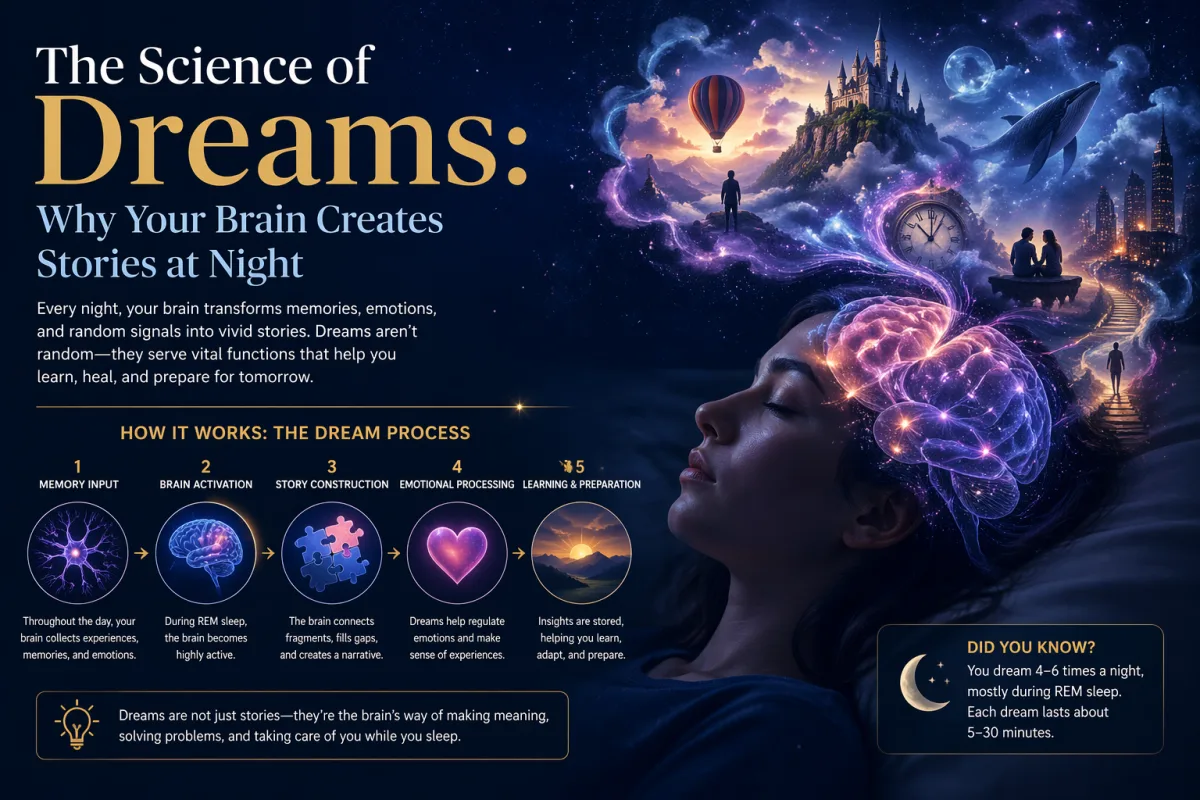
You close your eyes, drift off, and suddenly you're flying, or maybe you're back in high school taking a test you forgot to study for, or perhaps you're having a conversation with a talking animal. Dreams are a universal human experience, a nightly excursion into worlds crafted by our own minds. But what exactly is happening when your brain creates these intricate stories at night? The science of dreams offers a captivating look into this mysterious process, revealing not just random imagery, but a complex interplay of neural activity, emotional processing, and memory consolidation.
For centuries, philosophers and mystics have pondered the meaning of dreams. Today, neuroscientists and psychologists are peeling back the layers of this ancient enigma, using advanced brain imaging and sleep studies to understand the "why" and "how" behind our nocturnal narratives. It's a field brimming with discovery, continually reshaping our understanding of consciousness itself.
The Sleep Cycle and the Stages of Your Dream Factory
To understand why your brain creates stories at night, we first need to appreciate the intricate dance of sleep. Sleep isn't a monolithic state; it's a dynamic journey through several distinct stages, each playing a role in our physical and mental restoration. Most of us cycle through four to five such periods each night, lasting around 90 minutes each.
There are two primary types of sleep: Non-Rapid Eye Movement (NREM) sleep, which has three stages, and Rapid Eye Movement (REM) sleep. While dreams can occur in any stage, the vivid, narrative-rich, and often bizarre stories we remember most clearly almost exclusively happen during REM sleep. During this stage, your brain activity actually resembles that of wakefulness, yet your body is temporarily paralyzed, preventing you from acting out your dreams.
This paradoxical state – an active brain in a still body – is crucial. It’s during REM that the brain's limbic system, responsible for emotions, becomes highly active. Meanwhile, the prefrontal cortex, which handles logic and decision-making, significantly reduces its activity. This imbalance helps explain why dreams often feel intensely emotional but lack coherent reasoning or self-awareness. It's your personal movie theater, but the director's gone a bit wild.
Understanding Why Your Brain Creates Stories at Night: Key Theories
The question of "why we dream" has no single, universally accepted answer. Instead, the scientific community grapples with several compelling theories, each offering a piece of the puzzle. These aren't mutually exclusive; it's likely that dreams serve multiple functions.
Memory Consolidation and Emotional Regulation
One of the most robust theories is that dreams play a vital role in memory consolidation and emotional regulation. During REM sleep, your brain actively processes and reorganizes the day's experiences. It decides what information to keep, what to discard, and how to integrate new memories into existing knowledge networks.
Research, including studies by Dr. Robert Stickgold at Harvard Medical School, has shown that dreaming about a newly learned task can significantly improve performance on that task after waking. It's as if your brain is running simulations, refining skills and cementing knowledge.
Beyond facts and skills, dreams also help us process emotions. When you experience something emotionally charged during the day, your brain often revisits it in dreams, stripping away the raw emotion to allow for better psychological integration. This emotional "detox" can explain why recurring stressful events often appear in dreams, allowing your subconscious to work through them in a safe, simulated environment.
- **Activation-Synthesis Theory:** Proposed by J. Allan Hobson and Robert McCarley, this theory suggests dreams are merely the brain's attempt to make sense of random neural signals firing during REM sleep. The cortex takes these chaotic signals and synthesizes them into a coherent narrative, however strange it may seem.
- **Threat Simulation Theory:** Antti Revonsuo posited that dreams are an ancient biological defense mechanism, allowing us to practice dealing with threatening situations in a safe, simulated environment. This could explain the prevalence of nightmares or dreams where we're running from danger.
- **Problem-Solving Theory:** Some psychologists believe dreams offer a unique space for creative problem-solving. Unburdened by waking logic, the dreaming mind can make connections and explore solutions that might elude us in our waking state.
The Brain in Dreamland: A Neuroscientific Perspective
When you're dreaming, your brain isn't just passively receiving signals; it's a highly active, complex orchestrator. Functional MRI (fMRI) studies have given us unprecedented glimpses into the dreaming brain, confirming some theories and sparking new questions.
During REM sleep, we see heightened activity in areas associated with vision, emotion, and memory, such as the visual cortex, amygdala, and hippocampus. The brain stem, which generates the REM state, also plays a crucial role. Conversely, the dorsolateral prefrontal cortex, vital for executive functions like planning, logic, and self-awareness, shows reduced activity. This explains why we often accept bizarre dream scenarios without question – our internal fact-checker is on vacation.
Neurotransmitters also play a significant role. Acetylcholine levels are high during REM sleep, facilitating brain activity and memory processing. Norepinephrine and serotonin, typically associated with wakefulness and mood regulation, are almost completely shut down. This chemical cocktail creates the unique mental landscape of dreams, where emotions run high and logic takes a backseat.
The Bizarre Logic of Dreams: Why They Feel So Real Yet So Strange
One of the most perplexing aspects of dreams is their often surreal nature. Why does your brain present you with narratives that defy physics, time, and common sense, yet feel utterly real in the moment? It all comes back to that peculiar neurochemical state of REM sleep.
Without the critical oversight of the prefrontal cortex, your brain is free to make associative leaps that would never fly in waking life. It connects disparate memories, emotions, and sensory fragments into a narrative tapestry. This is why you might find your childhood home suddenly has an extra room, or a deceased loved one appears alongside a talking cat. Your brain isn't trying to be logical; it's trying to make a story out of the raw material it has, driven by emotional and memory-processing needs.
This 'dream logic' is a testament to the brain's incredible capacity for creativity. It's a continuous, often fantastical, improvisation. The symbols and metaphors that populate dreams aren't necessarily messages from a deeper self, but rather the brain's unique shorthand for processing complex information and feelings. For instance, being chased might symbolize anxiety about a real-life deadline, not necessarily a literal threat.
What Your Dreams Mean for You: Practical Takeaways
While dream interpretation can be subjective, understanding the science behind why your brain creates stories at night can offer valuable insights into your own mental landscape. Here's what this knowledge can mean for you:
- **Emotional Processing:** Recognize that your dreams are a natural outlet for processing daily emotions. If you're experiencing stress or anxiety, it's not uncommon for your dreams to reflect this. Don't dismiss nightmares; they're often your brain working hard to cope.
- **Memory and Learning:** Appreciate the role of sleep, especially REM, in solidifying learning and memory. Ensuring you get enough quality sleep isn't just about feeling rested; it's crucial for your cognitive function and ability to retain new information.
- **Problem Solving:** Pay attention to recurring themes or challenges in your dreams. While not literal solutions, they might highlight areas of your waking life that need attention. Some people find keeping a dream journal helps them identify patterns or even spark creative solutions.
- **Self-Awareness:** Your dreams are a unique window into your subconscious mind. They can reveal fears, desires, and unresolved conflicts that you might not consciously acknowledge. Exploring these narratives can foster greater self-understanding.
The science of dreams continues to evolve, constantly challenging our perceptions of consciousness and the sleeping mind. We're still far from unlocking every secret held within our nightly narratives, but each discovery deepens our appreciation for the astonishing complexity of the human brain. The next time you wake from a particularly vivid or strange dream, remember that it wasn't just random noise; it was your brain, hard at work, weaving stories to make sense of your world, process your emotions, and consolidate your memories, all while you peacefully slumber.