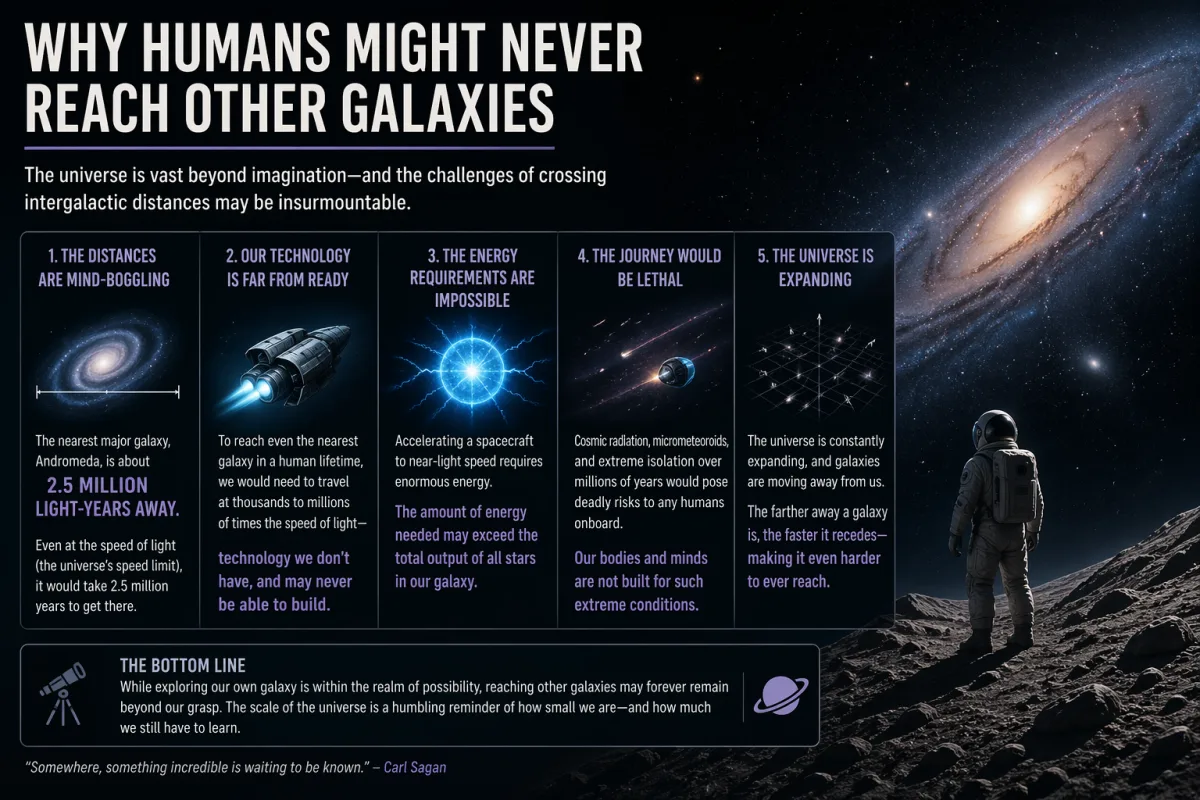
For centuries, humanity has gazed at the stars, dreaming of journeys beyond our solar system, beyond our galaxy. It's a powerful, almost primal urge, fueled by curiosity and the boundless imagination of science fiction. But while we've made incredible strides in space exploration, sending probes to the edge of our sun's influence and even capturing images of distant galaxies, the prospect of humans physically traveling to and exploring those other island universes remains a staggering, perhaps impossible, challenge. The reasons why humans might never reach other galaxies aren't just about current technology; they're deeply rooted in the fundamental laws of physics and the inherent fragility of human life.
The Mind-Boggling Scale of Intergalactic Distances
Our nearest galactic neighbor, Andromeda, is a staggering 2.5 million light-years away. To grasp this, consider that a light-year is the distance light travels in one Earth year – approximately 9.46 trillion kilometers. That's 2.5 million multiplied by 9.46 trillion kilometers. Even if we could travel at the speed of light, a journey to Andromeda would take 2.5 million years.
Our fastest spacecraft, like NASA's Parker Solar Probe, reached speeds of around 692,000 kilometers per hour relative to the Sun. That's incredibly fast by human standards, but it's a mere fraction – about 0.064% – of the speed of light. At that speed, reaching Andromeda would take nearly 4.5 billion years. That's older than Earth itself. This immense scale isn't just a number; it's a cosmic barrier that dwarfs our current capabilities.
Imagine the resources needed to sustain a journey for even a fraction of that time. We're not talking about sending a small probe; we're talking about transporting an entire civilization, or at least a self-sustaining ecosystem, across an expanse of vacuum that stretches beyond comprehension. It's a scale problem that makes even interstellar travel within our own Milky Way seem like a day trip.
Einstein's Speed Limit: Why We Can't Outrun Physics
The universe has a fundamental speed limit: the speed of light in a vacuum, roughly 299,792 kilometers per second. Einstein's theory of special relativity dictates that nothing with mass can ever reach or exceed this speed. As an object approaches the speed of light, its mass increases infinitely, requiring an infinite amount of energy to accelerate it further. This isn't a technological hurdle we can overcome with better engines; it's a bedrock principle of physics.
Even if we somehow engineered a spacecraft that could approach the speed of light, the journey would still take millions of subjective years for those observing from Earth. For the travelers on board, time dilation would mean their personal journey might be shorter, but they'd return to an Earth potentially millions of years in their future, if it even still existed. This raises profound questions about the purpose of such a journey. Are we exploring, or are we simply sending a time capsule into the void?
Hypothetical concepts like warp drives, popularized in science fiction, offer a tantalizing workaround by bending spacetime itself. While mathematically possible in some theoretical frameworks, the energy requirements for such a device are astronomical, demanding amounts of exotic matter or energy that we don't even know exist, let alone how to produce or control. It's science fantasy, not currently feasible physics.
The Crucial Resource Gap for Reaching Other Galaxies
A journey spanning millions of years demands self-sufficiency on an unprecedented scale. We're not just packing snacks; we're building a mobile, closed-loop ecosystem capable of sustaining human life and technological operations for countless generations. This isn't just about food and water; it's about every single resource:
- Energy: How do you power a vessel for millions of years? Nuclear fission fuel would deplete. Fusing hydrogen would require gargantuan reactors and fuel sources. Harvesting energy from sparsely distributed stars during the journey is incredibly inefficient.
- Materials: Every component of the spacecraft would need to be incredibly robust, self-repairing, or endlessly recyclable. Cosmic dust and radiation would degrade materials over eons.
- Population Genetics: Maintaining a healthy, diverse gene pool over hundreds of thousands of generations in a confined space presents immense challenges, risking inbreeding and genetic drift.
- Psychological & Sociological Stability: Can a small, isolated society remain cohesive and goal-oriented for millennia? History suggests long-term isolation can lead to unforeseen social dynamics and conflicts.
The Impossibility of Perpetual Motion: Fueling the Journey
Even if we could accelerate a ship to near light speed, the energy required to maintain that velocity, let alone decelerate and maneuver upon arrival, is mind-boggling. Current propulsion systems, even advanced ion drives, are orders of magnitude too weak and too slow. A hypothetical antimatter drive, while offering the highest energy density, would require producing and storing antimatter in quantities so vast they currently exist only in the realm of theory and minute laboratory experiments. The energy cost to create even a gram of antimatter is astronomical, let alone the tons needed for an intergalactic voyage.
Human Frailty: Our Biological Limits in Deep Space
Humans are fragile beings, evolved for life on a planet with a protective atmosphere and a stable gravitational field. Deep space is a hostile environment, and a multi-million-year voyage would expose us to existential threats:
- Cosmic Radiation: Beyond Earth's magnetic field and atmosphere, galactic cosmic rays and solar particle events bombard spacecraft. Long-term exposure increases cancer risk, causes neurological damage, and can be lethal. Shielding for millions of years against these particles would require impractically massive amounts of material.
- Microgravity: Extended periods in microgravity lead to bone density loss, muscle atrophy, cardiovascular deconditioning, and vision problems. While artificial gravity could mitigate some effects, its implementation on a generational vessel is a monumental engineering feat.
- Psychological Impact: Confinement, isolation, and the sheer length of the journey would take an unimaginable toll on mental health. Generations born and dying within the confines of a ship, never seeing a planetary surface, would face unprecedented psychological challenges. What would be their motivation? Their sense of purpose?
These aren't minor inconveniences; they're fundamental challenges to our very biology and psyche. We're simply not built for the kind of journey required to reach other galaxies.
A Cosmic Perspective: What Our Galactic Isolation Means
The realization that humans might never reach other galaxies isn't necessarily a defeat; it's a reorientation. It shifts our focus from an impossibly distant future to the incredible richness and mystery of our own cosmic backyard. What does this mean for you, for us?
It means cherishing and understanding our own planet, our own solar system, and our own Milky Way galaxy becomes even more vital. Instead of pouring potentially infinite resources into a journey that defies physics, we can invest in:
- Deepening Our Understanding: Developing advanced telescopes and probes to explore distant galaxies remotely, unlocking their secrets without ever leaving Earth.
- Protecting Our Home: Directing our ingenuity towards solving terrestrial problems and ensuring the long-term survival of humanity on the only habitable world we know.
- Exploring Locally: Focusing on colonizing Mars, establishing lunar bases, and perhaps even venturing to the outer planets and their moons – ambitious goals that are still within the realm of scientific possibility.
The universe is vast, breathtakingly beautiful, and filled with wonders we've only begun to glimpse. While the dream of stepping onto the shores of Andromeda might remain just that – a dream – the reality of our place in the cosmos offers its own profound lessons and endless opportunities for discovery. Our destiny, for now, appears to be deeply rooted in our own galactic home.
Perhaps true exploration isn't always about physical presence, but about expanding our understanding, pushing the boundaries of knowledge, and using our ingenuity to connect with the universe in ways that respect its fundamental laws. We may not touch the stars of other galaxies, but we can certainly see them, study them, and learn from them, enriching our human story without ever leaving our comfortable blue marble.