Why I Bought the YIHUA 959D
I've been tinkering with electronics for a few years now. Mostly through-hole stuff, but recently I needed to replace a faulty surface-mount (SMD) chip on a busted game console motherboard. My regular soldering iron just wasn't going to cut it for a multi-pin chip. I needed hot air. But looking at the prices of professional Hakko or Weller rework stations made my wallet cry. I stumbled across the YIHUA 959D online. It looked decent, had a digital display, and was cheap enough that I wouldn't feel guilty if I only used it a few times a year. So, I decided to pick one up here. After a solid month of using it for desoldering, heat shrinking, and even a little plastic welding, I have some strong opinions.
First Impressions and Build Quality
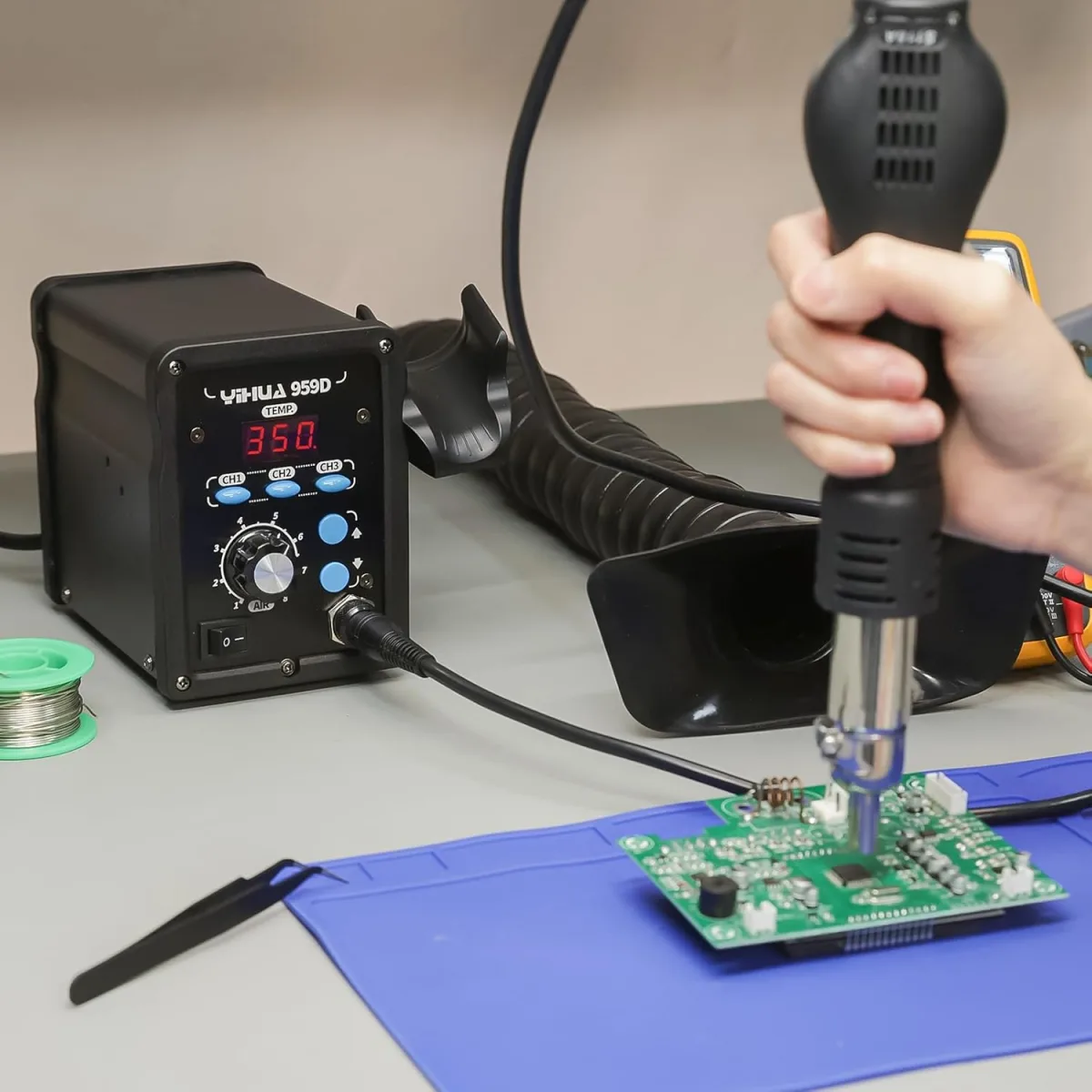
Out of the box, the base unit is surprisingly compact. It doesn't take up much room on my crowded workbench, which is a massive plus. The main base unit feels a bit light, mostly because the actual blower motor is located inside the handpiece itself, not in the base. This makes the handle slightly thicker and heavier than premium models where air is pumped through a hose. Honestly, it didn't bother me much once I got used to it, but it does feel slightly unbalanced at first.
The unit comes with three different nozzles. They twist and lock into place securely, though changing them while they are hot requires a pair of pliers since there's no quick-change mechanism.
Heating Speed and Daily Performance
This thing heats up incredibly fast. The manufacturer claims it ranges from 212°F to 932°F. I usually set it to around 350°C (about 660°F) to pull stubborn SOIC chips. It hits that target temperature in under 15 seconds. The airflow dial is smooth and responsive, letting you dial in just enough wind to melt solder without blowing tiny 0402 resistors off your board.
My absolute favorite feature is the auto-sleep function. When you place the handle back into the cradle, the station automatically ramps the fan up to maximum while cutting power to the heater. Once the element drops below 100°C, it shuts off completely. The moment you pick it back up, it immediately starts heating back to your set temp. This saves the heating element from burning out prematurely and prevents you from accidentally melting your cutting mat.
What Annoyed Me
It's not all perfect. The cable connecting the handle to the base is pretty stiff. It takes some wrestling to get it positioned comfortably when you're trying to do precision work. I found myself fighting the cord tension a few times.
Also, the temperature calibration isn't flawlessly accurate. I tested the output with a thermocouple and found it ran about 10 to 15 degrees cooler than the digital display claimed. It's not a dealbreaker by any stretch—you just learn to bump the dial up a tiny bit to compensate. When you check today's price, you'll easily see why I'm willing to forgive a minor temperature variance.
Pros
- Incredible value for the money
- Heats up to target temperature in under 15 seconds
- Auto-sleep and cool-down feature works flawlessly
- Compact footprint on the desk
- Includes three useful nozzle sizes
Cons
- The power cord leading to the handle is stiff and bulky
- Fan-in-handle design makes the wand slightly heavy
- Temperature runs slightly cooler than the display indicates
Who Should Buy This?
If you are a hobbyist, a DIYer, or someone who occasionally fixes broken electronics and game consoles, this is exactly what you need. It handles heat shrink tubing, desoldering SMD components, and reflowing solder joints brilliantly without breaking the bank. It's a massive upgrade over trying to use a standard heat gun from a hardware store.
Who Should Skip It?
If you run a daily repair shop, fix iPhones for a living, or need extreme thermal precision for highly sensitive components, skip this. You will want to invest in a higher-end station with a lighter handpiece and tighter temperature calibration. The stiff cord and slightly bulky handle might cause fatigue if you are holding it for eight hours a day.
Final Verdict
For my needs, the YIHUA 959D has been a fantastic addition to my bench. It paid for itself the very first time I used it to salvage a $100 motherboard. It has a few budget-level quirks, but the performance vastly outweighs the flaws. If you're on the fence about getting into hot air rework, I highly recommend you grab it on Amazon and start melting some solder.